


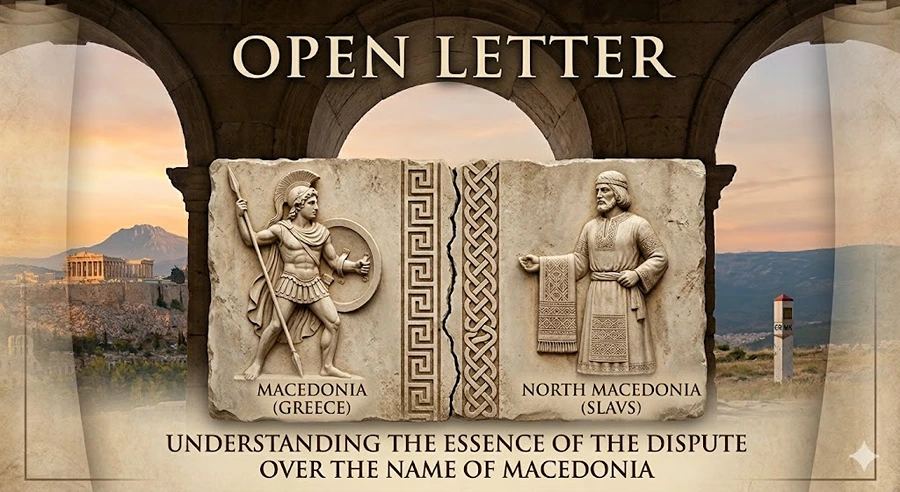

Understanding the Essence of the Macedonia Name Dispute
A Historical and Cultural Retrospective
In an era where misinformation poses a global threat, protecting our shared European heritage is more critical than ever. This open letter addresses the ongoing challenges concerning the Greece and North Macedonia relations following the Prespa Agreement of 2018. It sheds light on persistent instances of historical forgery and cultural appropriation, including the unauthorized use of the Vergina Sun and the distribution of propaganda maps that undermine regional stability.
We invite European citizens, policymakers, and academics to examine the facts, stand against revisionism, and defend the integrity of our common history.
Dear fellow citizens of the European Union, in our common European family, understanding, mutual respect and truth constitute the foundations of our coexistence. Often, issues concerning the Balkans seem complex or distant. One of these is the long-standing dispute between Greece and the state that is today named North Macedonia. To understand why this issue touches the hearts of Greeks so deeply, one does not need to be a diplomat. One simply needs to see the facts clearly and plainly, starting with the Historical Reality. Macedonia is not merely a geographical region; it is a pillar of ancient Greek history.
- The Ancient Macedonians: Alexander the Great, Philip II and the ancient Macedonians were a Greek tribe. They spoke the Greek language, believed in the gods of Olympus, and participated in the Olympic Games ( participation in which was allowed only to Greeks).
- The Arrival of the Slavs: The current inhabitants of North Macedonia are predominantly of Slavic origin. Slavic tribes migrated and settled in the wider Balkan region during the 6th and 7th centuries AD — namely, about a thousand years after the era of Alexander the Great.
The problem is not new, but it escalated after World War II.
- Lenin’s Communist International (Comintern), and later Stalin, engineered the creation of a ‘United and Independent Macedonia and Thrace‘ in order to control the region, involving Greek Macedonia, today’s North Macedonia, and Bulgarian Macedonia (Pirin).
- Within the framework of the unified Yugoslavia at the time, the region was named the ‘Republic of Macedonia’ for reasons of political expediency, aiming to secure Yugoslavia’s access to the Aegean Sea at the expense of the Greek state.
- When the country gained its independence in 1991, it appropriated the name ‘Macedonia’ as its exclusive right.
- NATO wanted the existence of the small state of North Macedonia in order to control the region and protect it from Moscow’s ambitions, thereby overlooking the forgery of History
A simple analogy: Imagine a neighboring country of France or Italy suddenly renaming itself “Gaul” or “Roman Empire”, changing its school textbooks to claim that Charlemagne or Julius Caesar were its own ancestors, and claiming their exclusive cultural heritage.
The Prespa Agreement (2018)
After decades of tensions, the Prespa Agreement was signed in 2018. Greece (at a state level), demonstrating a spirit of compromise and good neighborliness, accepted the name “North Macedonia” so that there would be a clear geographical distinction from the historical Greek region of Macedonia. This agreement legally clarified that:
- The language and culture of North Macedonia belong to the Slavic family and have no connection to the ancient Greek cultural heritage.
But on May 12, 2024, Gordana Siljanovska-Davkova was sworn in as President of North Macedonia during a special parliamentary session. During her oath, she referred to the country simply as ‘Macedonia‘, sparking widespread backlash for violating the Prespa Agreement and prompting the Greek Ambassador to North Macedonia to walk out of the ceremony.”
Additionally, on Sunday, May 10, North Macedonia’s Prime Minister, Hristijan Mickoski, participated in a monument unveiling ceremony in Albania. Speaking in the community of Tuminec (Municipality of Pustec, Prespa region), an area inhabited by a Slav-Macedonian minority, he once again used the name ‘Macedonia’ to describe his country.
Irredentism and Territorial Claims
Beyond the theft of history, the greatest concern of Greek Citizens over all these years was irredentism — meaning the cultivation of the idea among the citizens of North Macedonia that current borders are temporary and that there is an “enslaved” homeland that must be liberated. In the neighboring country, for decades, the nationalist narrative of a “United” or “Greater Macedonia” was developed at a state level (through school textbooks, state documents, and official events), which have not been abandoned even today.
- The Propaganda Maps: Within the framework of this narrative, maps were widely circulated showing their state expanding southward, incorporating the entirety of Greek Macedonia, reaching as far as Mount Olympus, and including Thessaloniki as the “capital” of this supposed Greater Macedonia.
- The Cultivation of Hatred: Generations of students and citizens in today’s North Macedonia grew up learning that the southern part of the so called Macedonia that appears in the maps below is under “Greek occupation” and that they themselves are victims of a historical injustice.
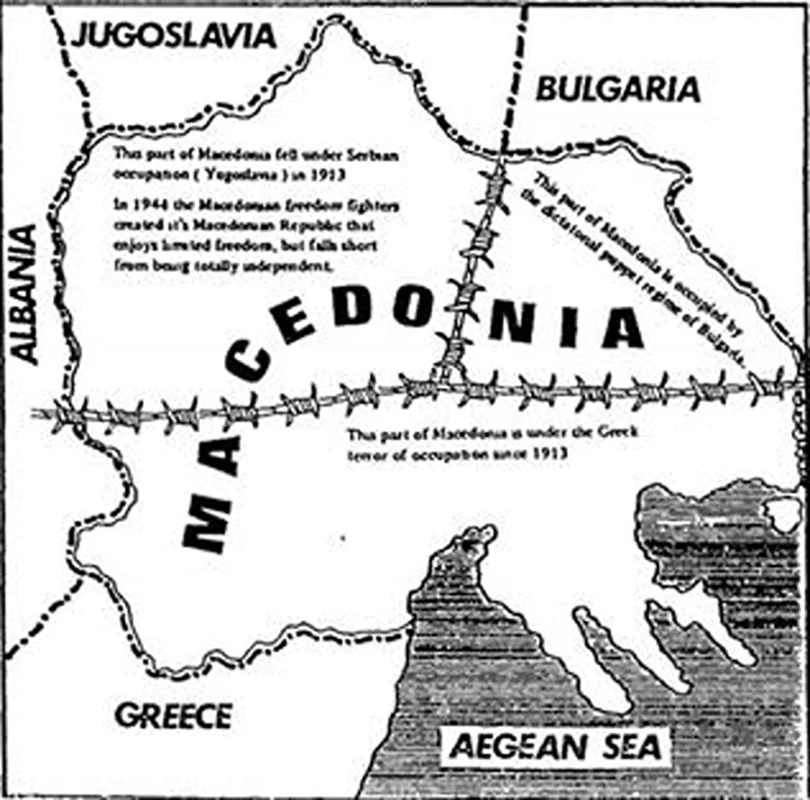
For Greece, this practice was and is not a mere theory. It is a direct, official challenge to international borders and a threat to peace in the Balkans. No European state would ever accept seeing a neighbor printing maps that amputate half of its territory.
Note: The Prespa Agreement forced North Macedonia to change its Constitution, removing any irredentist reference and explicitly recognizing that the existing borders are definitive and inviolable. However, this deeply rooted propaganda explains why Greeks remain extremely suspicious and sensitive to any attempt to violate it.
Why does it concern all of us as Europeans?
The European Union is based on truth, respect for history and good neighborly relations. The reaction of the Greeks is not a product of nationalism, but a need to protect historical identity from falsification. When we recognize North Macedonia by its official, geographical name and respect historical distinctions, we protect our common European cultural heritage. Because the history of ancient Macedonia is not only Greek — it is the foundation of the European civilization.
Sincerely,
A European Citizen


Website Open Forum
Scientific Union of Hellenic Armed Forces Medical Personnel
Post Curated by: Argiris Tasiopoylos